


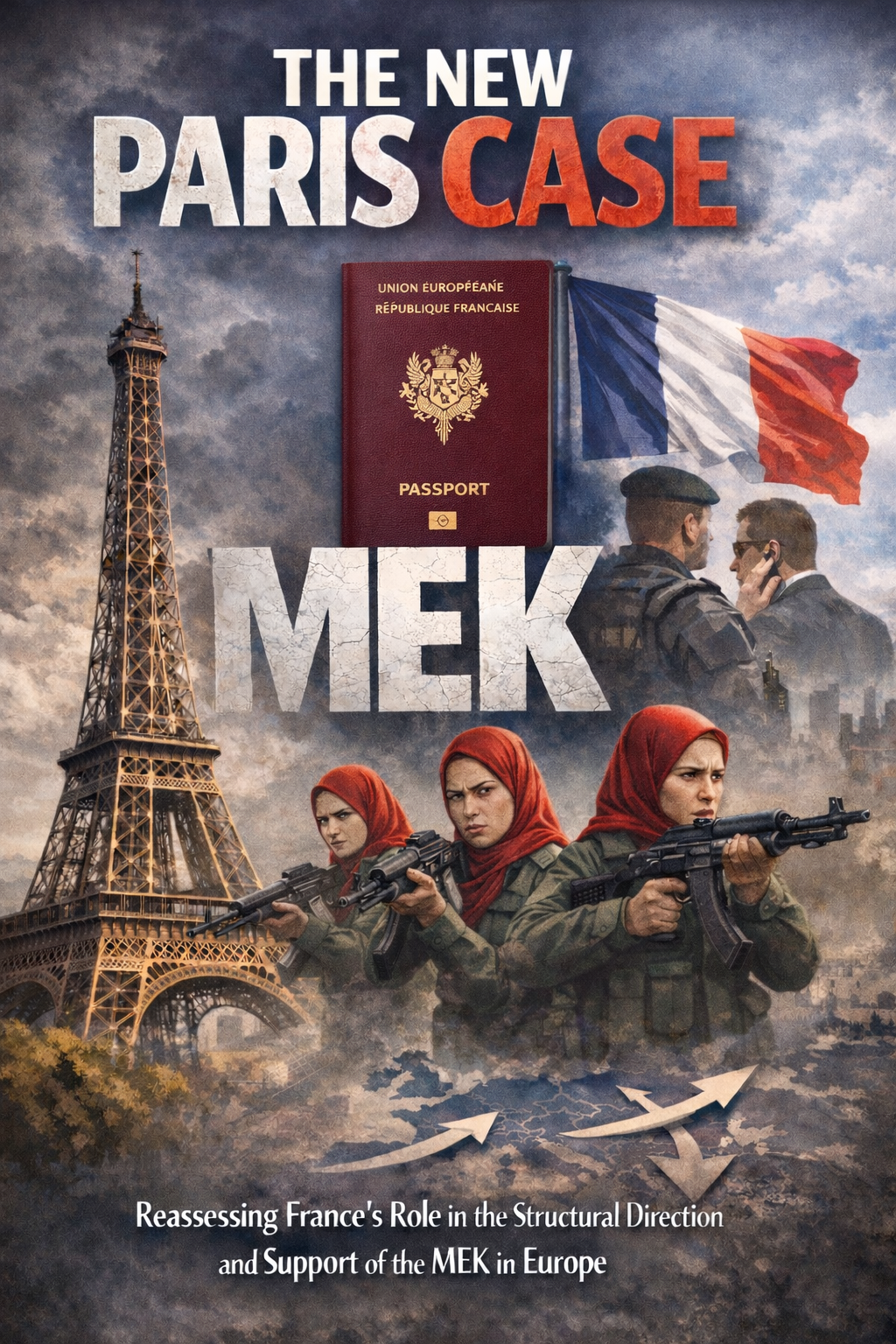
The disclosure of documents and information related to the presence and activities of the leaders of the terrorist group Mujahedin, known as the Monafeqin” (Hypocrites), in France has once again drawn public attention to the nature of the relationship between this terrorist group and the government of Paris. At the center of this case are the names of Maryam Rajavi (Qajar Azodanlou) and Zahra Merrikhi; two prominent figures of this group who have been based in Europe for years and, according to the published documents, have been granted original French passports with alternative and assumed identities under official cover. What emerges from this information is not merely political hosting or the granting of humanitarian residence, but rather presents a more complex picture of an organized and multilayered relationship in which France appears not as a neutral observer, but in the position of supporter, guide, and political beneficiary.
According to the published information, the alias “Parvaneh Hamedani” was used in identity documents for Zahra Merrikhi, and the alias “Farzaneh Darbahani” for Maryam Rajavi (Qajar Azodanlou). The granting of such identities, if accompanied by official backing and the issuance of valid European documents, cannot be considered merely an administrative action, but can be analyzed as a supportive mechanism; a mechanism that enables these individuals, under new identity cover, to travel across Europe, expand their communication networks, and benefit from the legal and economic capacities of the Schengen area.
The long-term presence of Maryam Rajavi in the suburbs of Paris and the continuation of her political and media activities cannot be imagined without some form of structural protection and facilitation. When such presence is accompanied by the granting of the assumed identity “Farzaneh Darbahani,” the issue goes beyond political residence and turns into a matter related to protective cover and operational facilitation. Likewise, the use of the name “Parvaneh Hamedani” for Zahra Merrikhi within official documents shows that the possibility of travel and activity under an alternative identity has been provided; an issue that makes tracking, monitoring, and legal accountability more complicated.
Under such circumstances, the concept of “political asylum” is elevated beyond its classical definition. Granting alternative identities to senior figures of a group with a history of terrorist and violent actions effectively creates a layer of immunity that can protect them from international prosecution. If this process has taken place with political will and full awareness, it indicates a form of targeted and structural support.
In this context, the historical record of the terrorist group Monafeqin, known as the Mujahedin-e Khalq Organization of Iran, shows that this group has played a role in numerous violent operations in past decades. In the 1970s, this group was involved in the assassination of several American advisers and citizens in Tehran; including the assassination of Colonel Lewis Hawkins in 1973 and several United States military contractors. After the 1979 Revolution, this group participated in a series of bombings and armed operations against officials of the Islamic Republic, the most important of which were the bombing of the Islamic Republic Party headquarters on 28 June 1981 and the bombing of the Prime Minister’s office on 30 August of the same year; events that led to the killing of dozens of senior political officials and are recognized in regional security literature as clear examples of organized violence.
In addition, during the period of this group’s establishment in Iraq and its mercenary cooperation with Saddam Hussein’s government during the Iran–Iraq war, it carried out military operations such as “Forough Javidan” (1988), which had a military cross-border nature and were accompanied by heavy casualties among the people of Iran. These records caused this group to be placed, at certain periods, on the terrorist lists of the United States and the European Union (although it was later removed from those lists). Referring to this background gains additional importance in analyzing the granting of alternative identities and the facilitation of the activities of the current leaders of the group; because the discussion is not merely about a political opposition group, but about a group that has a record of armed activity and violent operations.
Within this same framework, France’s relationship with the group affiliated with Maryam Rajavi and Zahra Merrikhi appears to have functional and instrumental dimensions rather than being passive. In recent years, this group has appeared as an active media and political actor against Iran in European capitals and has used official and semi-official platforms. The continuation of such an environment for Maryam Rajavi and the leadership circle of the group cannot be explained without the support and facilitation of the host government. From this perspective, the group under the leadership of these individuals can be analyzed as a proxy force that, in exchange for playing a political and propaganda role, has benefited from support, protection, and official cover.
However, a more important part of this case can be examined in the financial and economic sphere. The financial activities of this network in Europe, which are pursued under the structural guidance of the leadership of the group, including Maryam Rajavi, have long been a subject of discussion. From collecting resources under various titles to holding costly meetings and creating front structures, all indicate that this terrorist group has been able to gain access to significant resources within the legal framework of the European Union. If such activities have been facilitated through the use of assumed identities such as “Farzaneh Darbahani” and “Parvaneh Hamedani,” the issue goes beyond a political debate and enters the realm of serious money laundering crimes, non-transparent financial circulation, and exploitation of Europe’s economic mechanisms.
In such a context, the support of a European state for the presence and activity of figures such as Maryam Rajavi (Qajar Azodanlou) and Zahra Merrikhi does not merely mean accepting a political opponent, but can be analyzed as providing infrastructural conditions for the continuation of the organized network’s activities. This situation raises serious questions about financial supervision, anti–money laundering mechanisms, and double standards in dealing with groups that have a violent background.
From a political perspective as well, the continuation of the free presence and activity of Maryam Rajavi in France, along with the granting of alternative identity cover, raises the question of whether Paris is merely a host or has in practice turned into the political–security employer of this network. When a terrorist group uses the soil of a European country for media, informational, and political pressure against another government and its leaders are under official protection and facilitation, the relationship formed carries a meaning beyond simple residence.
Ultimately, the main issue is not merely the original French passports under the assumed names “Parvaneh Hamedani” and “Farzaneh Darbahani,” nor merely the physical presence of Zahra Merrikhi and Maryam Rajavi in France; rather, it is the nature of the relationship in which the granting of alternative identities, facilitation of movement within the Schengen area, exploitation of Europe’s financial capacities, and continuation of organized terrorist activity can all be analyzed within a supportive framework. Clarifying the dimensions of this relationship is what can determine whether we are faced with ordinary political asylum or with a model of proxy exploitation in which an organized group, under structural support, is placed in service of broader political objectives.
From a political standpoint, the continued free presence and activity of Maryam Rajavi in France, accompanied by the granting of alternative identity cover, raises the question of whether Paris is merely a host or has, in practice, become the political–security patron of this network. When a group with a terrorist background utilizes the territory of a European country to exert media, informational, and political pressure against another state, and its leaders operate under official protection and facilitation, the relationship formed exceeds that of simple residence.
Ultimately, the central issue is not merely the alleged issuance of authentic French passports under the assumed names “Parvaneh Hamedani” and “Farzaneh Darbahani,” nor solely the physical presence of Zahra Merrikhi and Maryam Rajavi in France. Rather, it concerns the nature of a relationship in which the granting of alternative identities, facilitation of movement within the Schengen area, access to European financial capacities, and the continuation of organized terrorist-related activity may all be analyzed within a supportive framework. Clarifying the dimensions of this relationship is essential to determining whether the situation reflects ordinary political asylum or a model of proxy utilization in which an organized group, under structural protection, operates in service of broader political objectives.