


Read as Permission
On Wednesday the Union told the Albanian police to hold back, received the opposition’s account in its own office, and said nothing to the men with the petrol. A security assessment of what a crowd does with three signals that point the same way.
By Drizan Shala (Security Desk)
Every crowd that intends violence runs a calculation before it moves, and the calculation has three inputs: what the police will do, what the political class will do, and what the outside powers that matter will say. In Tirana the outside power that matters is the European Union. On Wednesday afternoon the crowd had new readings on all three inputs, and the afternoon that followed is what the calculation produced.
A diplomatic statement during unrest is a signal, and it is read by three audiences at once. The government reads it for whether it still has cover. The opposition reads it for whether its account is accepted. The street reads it for whether the people who can hurt it, the police, have been told to hold back. A text that asks the police for proportionality and an investigation, and asks everyone else to calm down, is read by the third audience as the answer it wanted: the police are under watch, and nobody is watching us.
The Union knows how to send the other signal, because it sent it eight days earlier. On 6 October, with France in its third week of school protests, the Commissioner for Youth asked the French authorities for proportionality, especially with minors, and in the same statement condemned the violence against police, education staff and public property. That text was addressed to a police force that had by then detained more than five thousand people, most of them children, had fired rubber-bullet rounds at school gates, had taken a fifteen-year-old’s hand in Lens with a stun grenade and a fourteen-year-old’s teeth in Saint-Ouen-l’Aumône with a tear-gas round, and whose minister said the response was proportionate in almost all cases and would not apologise. The French street read the Commission’s text and found in it a sentence addressed to itself. The Tirana street read the Delegation’s and found none.
The rest of the Union shows what the signal normally is. The Commission does not, as a practice, address member states’ policing; it said nothing when Liège banned public gatherings and arrested more than 200 in a week, nothing when Brussels used baton charges and detained over a hundred in an evening, nothing when Valencia used rubber bullets on a housing march, nothing when Rome proposed preventive detention for demonstrators, nothing when The Hague banned a march. The exception it made for France carried a condemnation and named the victims. Where the Commission does address police is in candidate countries, and even there the form is fixed: when officers in Bitola were filmed beating Roma, the spokesperson condemned unjustified force and in the same sentence credited the North Macedonian authorities with having condemned it and opened an investigation. Name the police, credit the state. The Tirana text named the police and credited the state with nothing, including the condemnation of the attack on the Nunciature that the Albanian foreign ministry had issued four hours before.
The second input, the political class, moved the same afternoon. By the time the Delegation’s text was public, the Union’s ambassador had received the Democratic Party’s interlocutor for an hour, and the interlocutor had left the Union’s office to publish that the police must be held to account, that it must be established who gave the orders, and that European integration is measured by how power treats those who oppose it. The Delegation published nothing of its own. For the street, the reading is simple: the opposition’s account of the morning has been received in the Union’s room and has not been contradicted there.
The third input, the police, was set before the text and locked by it. After Tuesday night’s broken leg and the suspension of four officers and a station commander, the police came to Wednesday already pulled back; the Delegation’s text, arriving while that decision was still open, made the pullback the only posture the government could afford to be seen allowing. So the police used water cannon and tear gas, detained dozens without force, issued two appeals rather than orders, and by Shqiptarja’s own description followed a withdrawn strategy, avoiding contact under an almost continuous hail of stones. No rubber rounds, no stun grenades, no baton charge on any record, no ban on assembly. By the standard of any police force in the Union’s ledger this year, that is not proportionality; it is a decision to absorb.
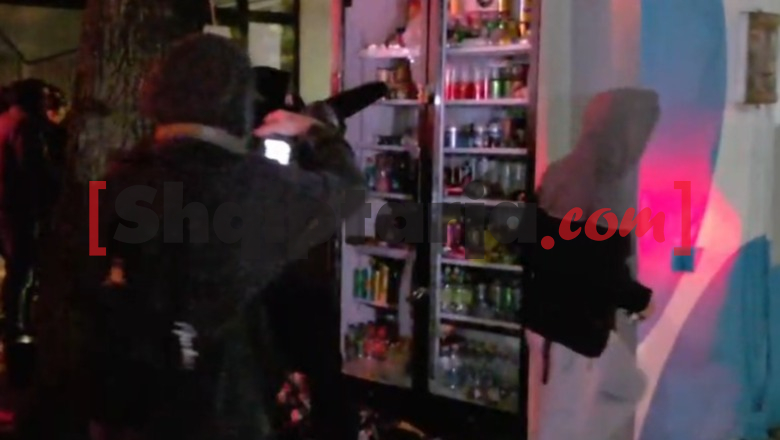
With all three inputs set, the afternoon was not a surprise. From four o’clock the crowd forced and ransacked the Ministry of Finance, set fire to the Ministries of Economy, Justice and Education, threw molotovs at the Prime Minister’s office, broke into the Assembly and lit fires inside, attacked the Constitutional Court, smashed the guard post of the Bank of Albania, burned two bank branches and a microcredit office, looted and torched the cafés at the Pyramid, emptied kiosks and set fire to whatever it reached, with no distinction between public and private property. Masks and gloves were distributed from bags. A camera was kicked apart. A UÇK flag was waved from a burning bin. The police held their line and the city behind it burned.
Nobody can prove that a text lit a molotov, and no serious analysis would try. What the record does show is that the Delegation made four choices on Wednesday, each with the other option available. It had the Commission’s three-part formula from eight days earlier and used two parts. It had an hour between its television answer and its own account, with the foreign ministry’s condemnation in front of it and the first bank already alight, and posted the text unchanged. It left out the one attack that touched its own protection in this city. And it received the opposition’s interlocutor and let her write the only account of the meeting. One of those is a lapse. Four, all pointing the same way, in a service where crisis statements are cleared before they go out, is a line. The only competing explanation is that the text was not Tirana’s at all but a common denominator cleared among member states, which would move the choice to Brussels without making it less of a choice. In the vocabulary of this trade the result is a permissive environment, and the record says it was not created by accident.
A permissive environment, once created, has a life of its own. The crowd that ran the calculation on Wednesday will run it again with Wednesday’s result as its baseline. The police planner who absorbed on Wednesday now knows the cost of absorbing and will be asked to do it again. And every actor in Tirana, including the ones the Delegation would prefer not to have taught, has learned that the Union’s first statement in a crisis is drafted for the opposition’s reading and posted unchanged while the city burns. That lesson does not expire when a better text is finally issued. It is already part of the calculation, and it was put there by the Union’s own hand.