


Every War Announces Itself
Pre-emptive wars are drafted before they are fought. Moscow published its draft. Belgrade is publishing.
By Drizan Shala | 4 August 2026
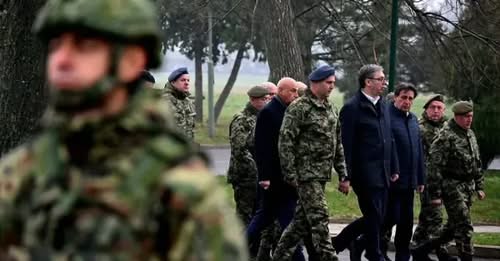
On Sunday, at a memorial to twelve Krajina refugees killed by Croatian aircraft in 1995, Serbia’s president said his country now fields an army fifty times stronger than the JNA, attacks no one, will always be able to defend its people, and is therefore sure of peace.
There is a control case for that sentence.
Between July 2021 and February 2022, Russia published every element of the justification for attacking Ukraine. An essay declaring Russians and Ukrainians one people. Eight years of the word genocide applied to Donbas, a crime no investigation ever found. An army massed under exercise cover while Moscow announced withdrawals, calling the warnings hysteria. On 24 February they assembled into one sentence: we were left no other way to protect our people. Nothing in it was new. Europe’s failure was a reading failure: years of published material, filed under rhetoric.
The genre has a rule. The projected threat describes the projector. Moscow accused Kyiv of planning an assault, then assaulted; alleged genocide, then left mass graves. The accusation assigns roles in advance, because the operation must arrive as a rescue.
Run Belgrade’s fortnight against the checklist. One people: at Rmanj monastery the Serbian president declared there are no Bosnian Serbs and no Croatian Serbs, only Serbs, and pledged the army to the borderless remainder, on Bosnian soil. The threat: “horrifying terror,” endangered Christians, “creeping ethnic cleansing,” a vocabulary that spikes with arrest warrants and never with events. The Eparchy of Raška-Prizren speaks of pressure. Belgrade speaks of terror.
Even the community being rescued declines the vocabulary of its rescue.
The capability: near-hypersonic missiles the president confirmed in March, the Israeli PULS system, and, by Kosovo’s defense ministry count, seventy percent of capacities facing one small neighbor, graded at Janjila by the buyer himself. The assurance: certainty of peace, in the same breath. Moscow’s calendar carried that entry nine days out.
In Ankara last month Croatia’s president asked what the arsenal is for and against what threat, and twice called it very strange. Belgrade responded but never answered. The answer arrives weekly, on tour.
It has been on paper since 1997, when the current president published it in his party’s magazine: wait while the world policeman is strong, remind the people daily, and when the balance shifts, take the territories, politically first and militarily if necessary. This justification is refillable. A ledger that converts an arrest, a permit or a licensing rule into an attack on our people can produce the intolerable act from stock, on any chosen morning.
Serbia is small, the objection runs, and its president will not burn his economy. Granted. But nobody builds a rescue narrative for storage.
Two sentences, one file. We were left no other way to protect our people: 24 February 2022, at launch. We will always be able to defend our people: 2 August 2026, in maintenance. The grammar is identical. The difference is a date, and dates are supplied by conditions. What Europe still controls is the date.